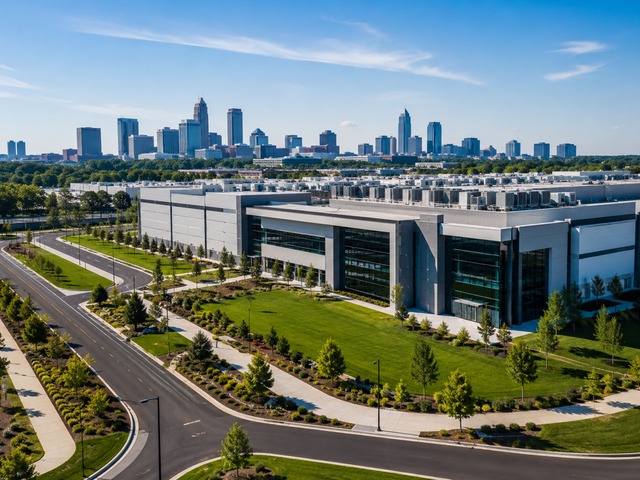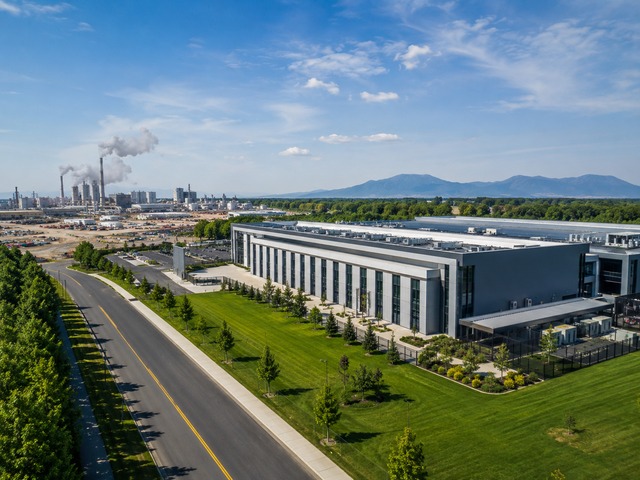
For municipal planners, finance directors, and elected officials, predictability is a core value in land use decision-making. A development that delivers what it promises — consistent tax revenue, stable employment, manageable operational impacts — is worth more to a community than a higher-headline alternative that carries more risk. On the predictability dimension, hyperscale data centers outperform virtually every competing land use category. Their revenue is consistent, their operational footprint is stable, their impacts are engineerable, and their long-term commitment to their locations is structurally enforced by the capital they embed in them.
The Revenue Predictability Advantage
Municipal finance depends on predictable revenue. Property tax projections, bond issuance, capital planning, and service delivery all depend on reliable assessments of what the tax base will produce year over year. Land uses that generate volatile or uncertain revenue — through assessment disputes, rapid depreciation, tenant turnover, or economic sensitivity — create planning uncertainty that affects the entire municipal finance picture.
Hyperscale data centers generate property tax revenue from a capital-intensive asset base that depreciates slowly and is not easily relocated. The building systems, power infrastructure, cooling equipment, and site improvements embedded in a hyperscale campus represent long-lived assets whose assessed value is stable over the planning horizons that matter for municipal finance. Unlike manufacturing facilities whose assessed values can decline sharply as equipment ages or processes become obsolete, data center infrastructure retains value because the underlying demand for computing capacity continues to grow.
The National League of Cities confirms that as the commercial property tax base grows from data center operations, it results in greater revenue for municipal services benefiting local citizens. Microsoft’s community fact sheet identifies property taxes as one of the primary ongoing community contributions of data center operations — collected annually once land is purchased and compounding as facility expansions add to the taxable base.
Operational Predictability for Planning Purposes
Data centers are highly regulated facilities with well-documented operational profiles. Traffic generation is modest and predictable — the same small staff operating in rotating shifts, the same occasional delivery pattern. Noise generation is engineered to comply with ordinance requirements and does not escalate over time as operations intensify. Utility consumption is large but stable — a data center running at design capacity consumes power at a predictable rate that utilities can plan around.
This operational predictability has direct value for municipalities. Planning departments can forecast the service demands that a data center will place on public infrastructure — roads, utilities, emergency services — with high confidence. There are no unexpected operational intensifications, no seasonal surges in activity, no supply chain disruptions that cause sudden changes in traffic or utility demand patterns. The facility operates consistently within the parameters established during the permitting process.
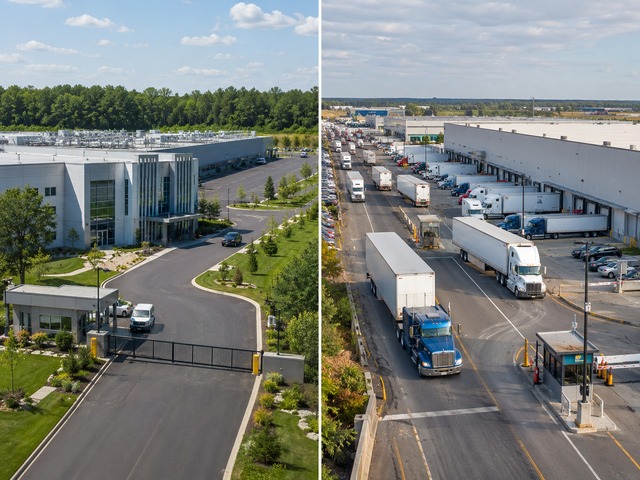
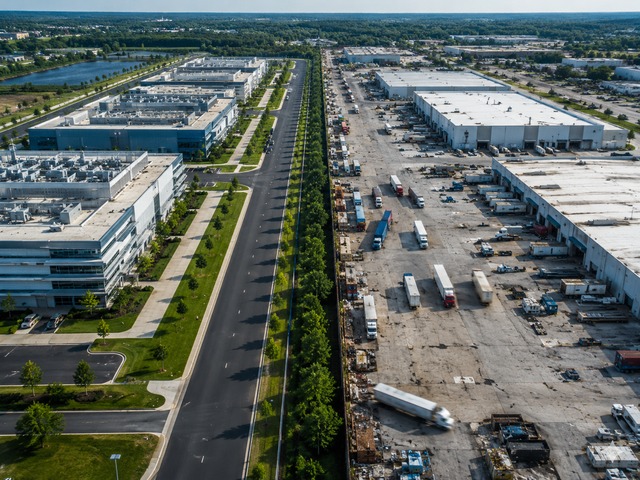
Compare this to logistics development. A major fulfillment center may ramp up to double its normal staffing during peak seasons, generating traffic and utility demand spikes that strain infrastructure designed for average conditions. A manufacturing facility may add shifts, expand production lines, or change processes in ways that alter its impacts on surrounding infrastructure. Data centers do not behave this way. Their operational profile is stable by design.
Investment Commitment: The Switching Cost Argument
Perhaps the most powerful predictability argument for data centers is structural: the capital embedded in a hyperscale facility creates switching costs so high that relocation is essentially irrational. A data center campus with hundreds of millions of dollars in embedded infrastructure — specialized power systems, cooling equipment, fiber connectivity, security systems — cannot be cost-effectively disassembled and relocated. The investment is site-specific and permanent.
This structural commitment means that communities hosting hyperscale data centers are not vulnerable to the relocation risk that affects other industrial investments. Manufacturers facing labor cost differentials, logistics operators reconfiguring distribution networks, and retail tenants responding to market shifts can all vacate facilities with relatively short notice. Hyperscale data center operators cannot. The capital they have committed to a location is the strongest form of long-term promise that the development community can offer.
The global data center industry is growing at 11.7 percent annually, driven by demand for AI computing, cloud services, and digital infrastructure that shows no structural sign of declining. A hyperscale facility operational today is not just committed to its location by sunk cost — it is operating in a growth market that will continue to demand its services for the foreseeable future.
Predictable Permitting Outcomes
For municipalities developing frameworks for data center approval, the well-documented operational profile of these facilities makes permitting outcomes more predictable than for more variable industrial uses. Traffic studies, noise models, utility impact analyses, and environmental assessments can be completed with confidence for a land use whose characteristics are well-understood. Permit conditions that establish specific performance standards — decibel limits at property lines, traffic management plans, utility demand caps — can be monitored and enforced with relatively low administrative burden because the operational profile of the facility is stable.
This predictability reduces the regulatory risk that municipalities face when approving large industrial developments. A data center that is permitted to specific performance standards is likely to operate within those standards indefinitely, because its operational profile does not change materially over time. The permit conditions negotiated at approval remain appropriate throughout the facility’s operating life.
Why This Matters
Predictability is an undervalued asset in economic development decision-making. Communities that prioritize predictability alongside headline metrics like job count and investment volume consistently find that data center development delivers on its promises in ways that more variable industrial alternatives do not. The revenue is stable. The impacts are manageable. The commitment is permanent. For municipalities building long-term financial plans, capital budgets, and service delivery frameworks around the tax base their development pipeline will produce, predictability is not a secondary consideration — it is a primary one. Data centers deliver it.
about
avada factory
Sempery ultricies nibh at dolor cras urna eleifend nec. Atiam efficitur tempor.