Resiliency is not an optional feature in data center design — it is the engineering foundation on which everything else is built. The services that flow through modern data centers — cloud computing, AI workloads, financial systems, healthcare records, communications infrastructure — cannot tolerate downtime. A single hour of outage at a hyperscale facility can represent hundreds of millions of dollars in economic impact for the organizations and individuals that depend on its services. The design response to that requirement is a discipline of redundancy, failover engineering, and long-term stability planning that represents some of the most sophisticated infrastructure engineering in the built environment.
The Tier System: Defining Resiliency Standards
The data center industry has developed a standardized framework for defining and communicating resiliency levels. The Uptime Institute’s Tier classification system rates facilities from Tier I through Tier IV, with increasing levels of redundancy and fault tolerance at each tier. Hyperscale facilities operated by major cloud providers typically target Tier III or Tier IV specifications.
Tier III facilities are concurrently maintainable — any component of the facility infrastructure can be serviced or replaced without interrupting operations. This requires redundant delivery paths for power and cooling, and sufficient capacity in backup systems to maintain full operations while primary systems are serviced. Tier IV adds fault tolerance: a single failure anywhere in the facility infrastructure — including component failures during maintenance — does not interrupt operations. Tier IV specifications represent the highest commercially defined standard of data center resiliency.
These classifications reflect engineering commitments that translate into significant capital investment. Redundant power feeds from separate utility substations, multiple UPS systems with independent battery strings, N+1 or 2N generator configurations, redundant cooling systems with automatic failover, and redundant network connectivity paths from diverse fiber providers — each element of resiliency adds cost, but each element also adds the long-term stability that makes hyperscale facilities reliable anchors for the communities that host them.
Power Redundancy: The Critical Path
Power is the most critical single input to data center operations. A facility that loses power loses everything — servers go offline, cooling stops, and the sensitive equipment that represents hundreds of millions of dollars in investment is at risk. The power redundancy architecture of a hyperscale data center is therefore engineered with extraordinary care.
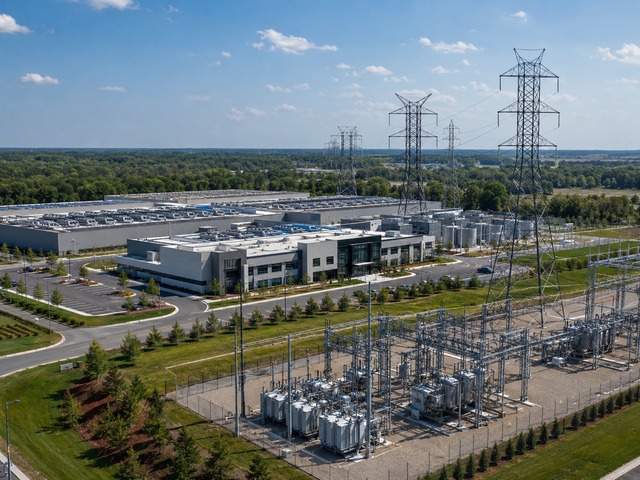
The standard approach involves multiple independent utility feeds from separate substations, ideally on separate transmission circuits. If one utility feed fails, the others maintain power delivery. Automatic transfer switches detect feed failures in milliseconds and switch to backup sources without interruption to facility operations.
Between the utility feed and the servers, uninterruptible power supply systems provide a buffer against the brief interruptions — sags, spikes, and momentary outages — that occur on any utility grid. UPS systems store energy in battery banks or flywheel systems and condition power to the precise specifications required by sensitive computing equipment. When utility power fails, UPS systems provide continuous power while backup generators start and assume the load.
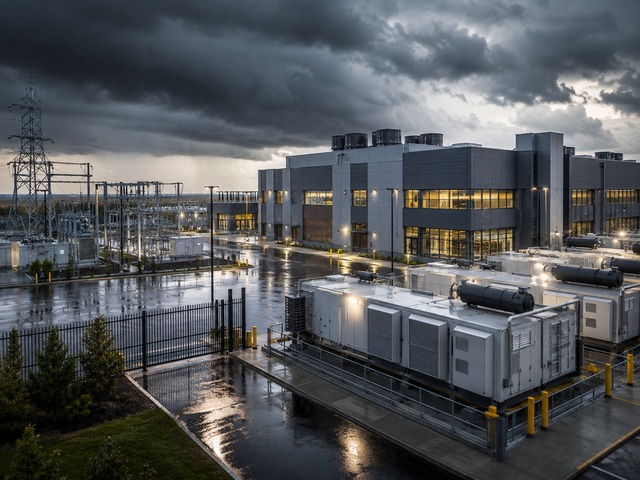
Backup generators at hyperscale facilities are not the single units found at smaller commercial buildings — they are arrays of large diesel or natural gas generators capable of powering the entire facility load indefinitely, constrained only by fuel supply. Fuel storage on-site provides days of runtime at full load, and contracts with fuel suppliers ensure resupply even during regional emergencies.
Cooling Redundancy
Cooling systems are the second critical redundancy domain. Servers generate heat continuously, and cooling failure can cause hardware damage within minutes. Hyperscale cooling systems are designed with the same redundancy philosophy as power systems: multiple independent cooling loops, automatic failover between cooling units, and sufficient standby capacity to maintain cooling even when primary systems are out for maintenance.
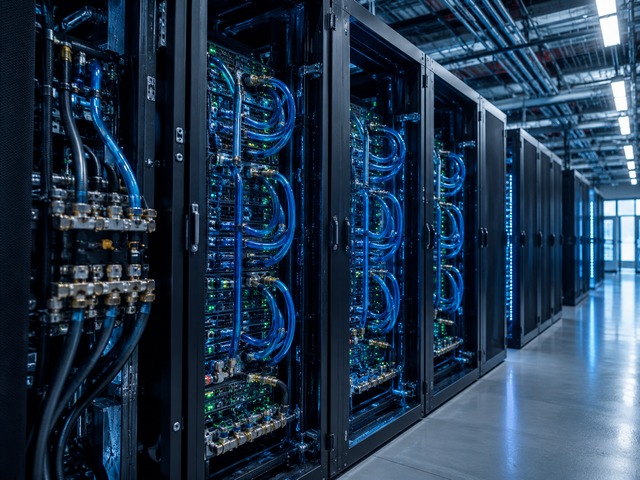
The integration of liquid cooling technology has added a new dimension to cooling redundancy. Facilities with both air-side and liquid-side cooling infrastructure have inherent redundancy between cooling modes — if one system is impaired, the other can maintain server temperatures within acceptable ranges. This architectural diversity reduces single-point-of-failure risk in cooling infrastructure and provides operators with operational flexibility during maintenance events.
Network Connectivity Redundancy
A data center that is powered and cooled but cannot communicate with the outside world has failed its operational purpose. Network connectivity redundancy therefore receives the same engineering attention as power and cooling. Hyperscale campuses are connected to the internet and to cloud backbone networks through multiple fiber paths from diverse providers, entering the facility from geographically separate locations to eliminate the risk of a single cut fiber cable interrupting connectivity.
Internal network architecture within hyperscale facilities is similarly redundant — multiple switching layers, redundant interconnects, and automatic rerouting of traffic in response to equipment failures ensure that connectivity is maintained even through significant internal network events.
Long-Term Stability as a Community Benefit
The resiliency engineering of hyperscale data centers has a dimension that matters directly to the communities hosting them. A facility designed to Tier III or Tier IV specifications is designed not just for operational continuity for its customers — it is designed for long-term stable operation as a physical facility. The mechanical systems, electrical infrastructure, and structural systems are engineered to operate reliably for decades with appropriate maintenance.
This long-term stability orientation means that hyperscale data centers age gracefully. Unlike manufacturing facilities whose equipment becomes obsolete and whose buildings require costly adaptation as production processes change, data centers are designed as platforms that can be continuously updated — servers replaced, cooling systems upgraded, electrical infrastructure expanded — without requiring fundamental changes to the building or site. A well-designed data center built today can operate as viable infrastructure for 20 to 30 years or more, providing stable tax revenue, employment, and community infrastructure investment throughout its useful life.
Why This Matters
The resiliency engineering discipline that governs hyperscale data center design is one of the strongest arguments for their long-term value as community investments. These facilities are built to last, engineered to operate continuously through failures that would shut down less sophisticated industrial infrastructure, and designed to maintain their operational value as technology evolves. Communities that understand the resiliency architecture of modern data centers — and the long-term stability it implies — are better positioned to evaluate the full value of hosting them. The upfront capital commitment reflects a long-term operating philosophy that benefits host communities for decades.
about
avada factory
Sempery ultricies nibh at dolor cras urna eleifend nec. Atiam efficitur tempor.