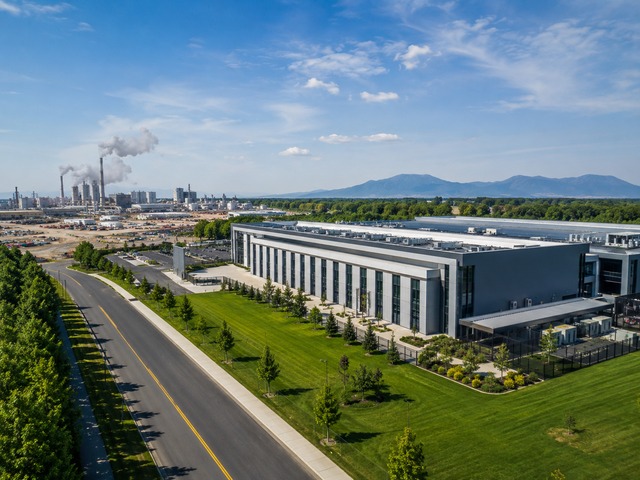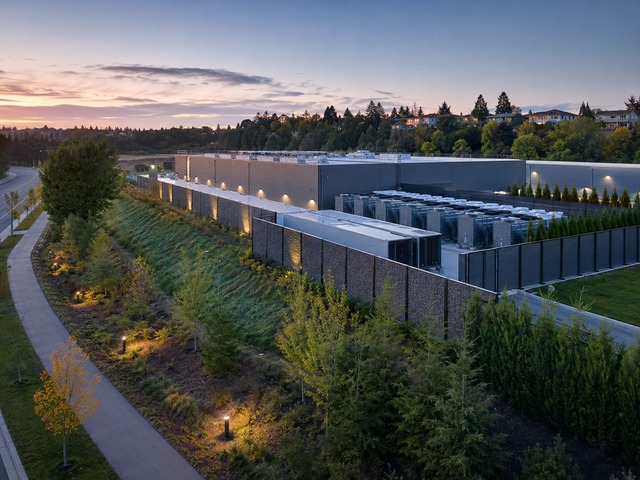
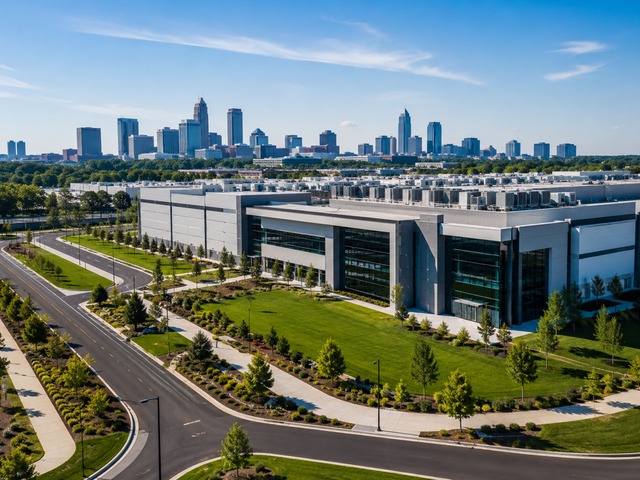
Economic development decisions are ultimately about return on investment — for communities, landowners, and the public. When the full economic profile of hyperscale data center development is compared against alternative land uses competing for the same sites, the data center consistently delivers superior outcomes on the metrics that matter most: tax revenue per acre, employment quality, long-term investment stability, and community infrastructure benefits. Understanding that profile requires moving beyond the headline job count — the metric most communities use to evaluate industrial proposals — to a fuller accounting of what data center development actually delivers.
The Tax Revenue Advantage
Hyperscale data centers are capital-intensive facilities. A single large campus can represent billions of dollars in infrastructure investment — power systems, cooling infrastructure, servers, networking equipment, building systems, and the real estate itself. This capital intensity translates directly into property tax assessments that significantly exceed those of lighter industrial uses on equivalent land areas.
Microsoft’s community fact sheet identifies multiple tax categories that data center operations generate: property taxes collected annually once land is purchased, indirect taxes from construction and operational expenses, and income taxes from construction and operations workers. The property tax contribution is particularly significant because it is ongoing, predictable, and scales with the assessed value of a capital-intensive facility that depreciates slowly.
The National League of Cities confirms that data center facilities can provide significant tax revenue benefits for communities, including revenue for municipal services that benefit local citizens. As the commercial property tax base grows from data center assessment, it results in greater revenue for the full range of municipal services — schools, public safety, infrastructure maintenance, and general government operations.
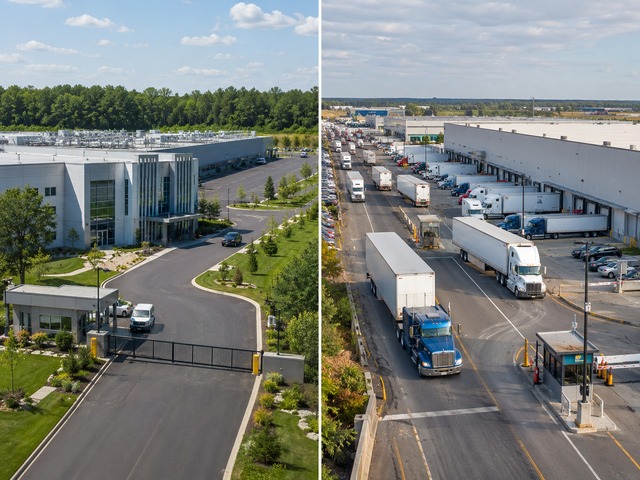
The comparison with logistics development is instructive. A warehouse facility on the same parcel generates property tax based on the value of a simpler structure — four walls, a roof, loading docks, and a slab floor. The assessed value per square foot is far lower than a hyperscale data center with its embedded electrical infrastructure, cooling systems, and specialized building systems. The tax yield per acre of a data center campus consistently exceeds that of warehouse development, often by a factor of two to five.
Employment: Quality Over Quantity
Data centers are not high-employment facilities in the conventional sense. A hyperscale campus may directly employ 200 to 500 people in full-time operations roles — far fewer than a logistics facility of comparable acreage that might employ thousands of hourly workers. This comparison often leads communities to undervalue data centers relative to warehouses from an employment perspective.
The comparison is misleading when employment quality is considered. Data center operations employment is concentrated in skilled technical roles: mechanical and electrical engineers, IT operations specialists, security professionals, and facility managers. These are family-wage positions with benefits and long-term stability. Microsoft’s fact sheet notes that construction phases generate substantial employment for electricians, plumbers, pipefitters, carpenters, structural workers, and concrete specialists — trades that command premium wages.
Logistics employment, by contrast, is concentrated in hourly warehouse labor at wages that rarely rise above entry level. Turnover rates in fulfillment centers are among the highest in any industry. The employment quality — measured by wages, benefits, stability, and career advancement — at a hyperscale data center significantly exceeds that of a comparable logistics facility, even if the raw headcount is lower.
The indirect employment multiplier from data center development also deserves attention. High-wage data center employment supports local spending on housing, retail, restaurants, and services at higher levels per employee than hourly logistics employment. The community economic impact per job created at a data center is therefore substantially higher than the impact per job at a logistics facility.
Long-Term Investment Stability
The capital structure of hyperscale data center investment creates a fundamentally different risk profile from speculative industrial development. A hyperscale campus represents infrastructure that is deeply embedded in its location — power connections, fiber routes, cooling systems, and building systems that cannot be cost-effectively relocated. The switching costs associated with abandoning an operational hyperscale facility are enormous.
This structural reality translates into investment stability that communities hosting data centers consistently experience. The global data center industry is projected to grow from $269 billion in 2025 to more than $580 billion by 2032 — an annual growth rate of 11.7 percent. The demand drivers — AI workloads, cloud computing, digital services — show no structural sign of reversing. Communities that secure hyperscale investments today are anchoring long-term revenue streams, not absorbing temporary occupants.
Logistics facilities, by contrast, are highly mobile. Distribution networks are reconfigured regularly as population centers shift, e-commerce patterns evolve, and supply chains reorganize. A major fulfillment center can go dark with 60 to 90 days notice when a tenant consolidates operations or relocates to a more cost-effective market. The tax base it represented disappears with it.
Digital Connectivity as an Economic Development Asset
Hyperscale data center development improves digital connectivity in the communities it serves. The fiber infrastructure required to serve a major data center campus is substantial, and the routes laid to serve the facility frequently improve connectivity options for other commercial and institutional users along the same corridors. Communities that host data centers benefit from improved broadband infrastructure as a secondary effect of the primary investment.
The National League of Cities identifies enhanced digital connectivity as one of the key community benefits of data center development. In rural and suburban markets where broadband infrastructure has historically lagged urban areas, the infrastructure investment triggered by a major data center proposal can close connectivity gaps that affect economic competitiveness for all local businesses.
The Full Accounting
When economic development decisions account for the full profile of data center investment — assessed value and tax yield per acre, employment quality and wage levels, long-term investment stability, infrastructure co-investment, and connectivity benefits — the comparison with alternative industrial uses consistently favors the data center. The headline job count is the wrong metric for evaluating this comparison. The right metrics are revenue durability, investment permanence, employment quality, and the infrastructure value that the development triggers.
Why This Matters
Communities that evaluate data center proposals using the same framework applied to logistics development — headcount, construction cost, land area — systematically undervalue what data center investment delivers. The economic case for prioritizing data center development over lower-quality industrial alternatives is strong, and it rests on metrics that local governments already use to evaluate economic development: tax base growth, employment quality, investment stability, and infrastructure improvement. The data center wins on all of them.
about
avada factory
Sempery ultricies nibh at dolor cras urna eleifend nec. Atiam efficitur tempor.