The rise of AI workloads has fundamentally changed what data centers need to do to stay cool. Traditional air cooling, adequate for conventional server racks, cannot efficiently manage the heat densities generated by modern AI accelerators. A single AI training server may generate four to five times the heat of a conventional enterprise server in the same physical footprint. The industry response — a rapid shift toward liquid cooling at the server and rack level — is driving efficiency gains, reducing environmental impact, and reshaping the physical footprint of data center infrastructure.
Understanding this shift matters not just for the technology sector, but for the communities and landowners evaluating data center proposals. The cooling technology a facility uses directly affects its noise profile, water consumption, energy efficiency, and long-term environmental impact.
Why Cooling Is the Central Engineering Challenge
Every computational operation generates heat. Processors, memory, power conversion equipment, and networking hardware all dissipate energy as heat during normal operation. Managing that heat — keeping hardware within its rated operating temperature range — is the fundamental engineering challenge of data center operations.
In conventional data centers, air cooling addresses this challenge by circulating conditioned air through server aisles. Mechanical systems cool the air, distribute it through raised floors or overhead ducts, pull it through server chassis, and reject the resulting warm air through heat exchangers to the outside environment. The system works but is thermodynamically inefficient: air has low thermal capacity relative to its volume, requiring large volumes of air movement to transfer meaningful amounts of heat.
As server power densities increase — driven by AI accelerators that pack massive computational power into dense hardware configurations — air cooling reaches its practical limits. Moving enough air to cool a rack of AI accelerators requires mechanical systems that are noisy, space-intensive, and energy-hungry. The alternative is to bring the cooling medium — typically water or a dielectric fluid — directly to the heat source at the server level.
Liquid Cooling: Direct, Efficient, and Scalable
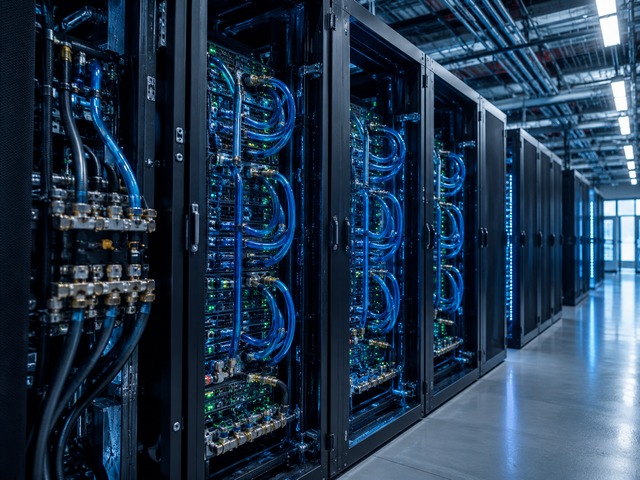
Liquid cooling encompasses several distinct technologies, each suited to different server types and deployment contexts. Direct liquid cooling (DLC) runs cooling plates directly attached to processors and memory modules, removing heat at the source with high efficiency. Immersion cooling submerges entire servers in tanks of dielectric fluid, which absorbs heat directly from all components simultaneously. Rear-door heat exchangers mount on the back of server racks and use water-cooled panels to absorb heat from server exhaust air before it reaches the room environment.
Each of these approaches is more thermodynamically efficient than air cooling for high-density applications. Water has approximately 3,500 times the heat capacity of air by volume, meaning a small flow of water can remove the same heat as a large volume of conditioned air. This efficiency advantage translates directly into lower energy consumption for the cooling system itself — which is significant, because cooling infrastructure can account for 30 to 40 percent of a data center’s total energy consumption in air-cooled facilities.
The Power Usage Effectiveness (PUE) metric measures how efficiently a data center uses its total power — the ratio of total facility power to IT equipment power. A PUE of 1.0 would mean all power goes to computing; every value above 1.0 represents overhead from cooling, lighting, and power distribution. Industry-leading hyperscale facilities achieve PUE values approaching 1.1 to 1.2, compared to a historical industry average closer to 1.5 to 2.0. Liquid cooling is a primary driver of these efficiency improvements.
Adiabatic and Free Cooling: Reducing the Mechanical Load
Beyond liquid cooling at the server level, modern data centers deploy additional efficiency strategies at the facility level. Adiabatic cooling uses evaporative principles to pre-cool outdoor air before it enters mechanical cooling systems, reducing the refrigeration load required to bring air to the required supply temperature. Air-side economization — using outside air directly for cooling when outdoor temperatures are sufficiently low — can dramatically reduce mechanical cooling energy in cooler climates.
Microsoft has implemented adiabatic cooling at facilities where climate conditions allow, reducing reliance on water-intensive traditional cooling while maintaining efficiency. The company’s cooling strategy is location-specific: facilities in cooler climates can exploit economization for a larger fraction of annual hours, while facilities in warmer climates rely more heavily on mechanical cooling or liquid cooling technology.
The selection of cooling technology has direct implications for a facility’s water consumption. Evaporative cooling systems consume water to provide cooling effect. Air-cooled and liquid-cooled systems that use closed-loop water circuits recirculate water rather than evaporating it. The trend toward liquid cooling for high-density AI workloads, combined with water-positive commitments from major operators, is driving investment in cooling systems that minimize water consumption while maintaining efficiency.
The Environmental Case for Modern Cooling
The efficiency gains from advanced cooling technology translate into direct environmental benefits. A data center that consumes 20 percent less energy to deliver the same computing output produces proportionally less carbon — whether that carbon is associated with grid electricity or backup generation. As the grid decarbonizes through renewable energy penetration, the efficiency advantage compounds: a more efficient facility benefits more from a cleaner grid than an inefficient one.
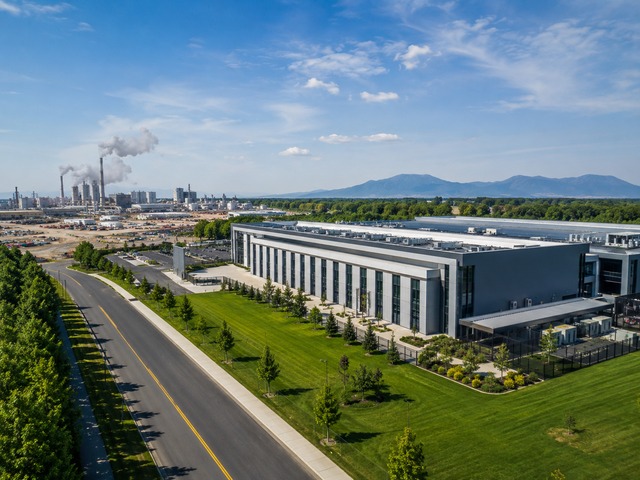
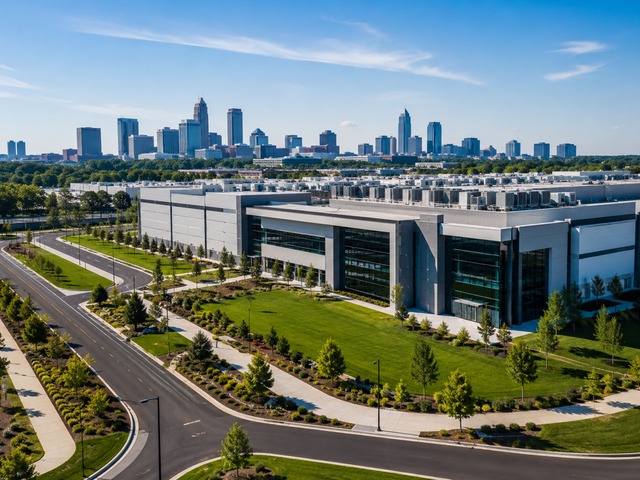
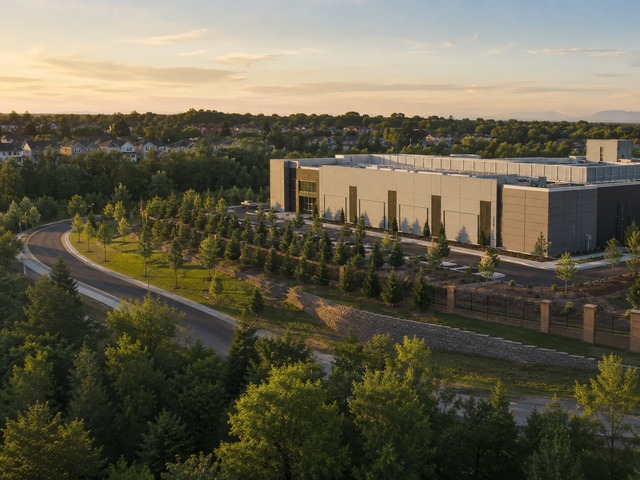
Reduced outdoor mechanical equipment — a direct consequence of shifting heat rejection from large air-side systems to smaller liquid-side systems — also reduces the noise and visual footprint of data center facilities. A facility that rejects heat through compact liquid cooling heat exchangers rather than rows of large cooling towers or dry coolers has a smaller outdoor equipment presence, lower noise output, and a reduced visual impact on neighboring properties.
The global data center industry is projected to grow from $269 billion in 2025 to more than $580 billion by 2032, according to the National League of Cities. As AI workloads drive that growth, the cooling technology choices made by operators today will determine the environmental footprint of the next generation of digital infrastructure.
Implications for Site Selection and Land Use
The cooling technology choices of modern data centers have direct implications for site selection and land use decisions. Facilities designed for liquid cooling require different infrastructure than traditional air-cooled facilities: water supply and treatment systems, specialized piping, and in some cases higher-capacity electrical feeds for the thermal management systems.
For landowners and communities evaluating data center proposals, the cooling technology specification is a meaningful indicator of facility quality and environmental performance. A facility designed around advanced liquid cooling and economization is likely to be more energy-efficient, quieter, and less visually imposing than one relying on conventional air cooling with large outdoor mechanical systems. It is also likely to represent a longer-term, more capital-intensive investment — a facility built to serve AI-era workloads rather than conventional IT loads.
Why This Matters
The shift to liquid cooling in AI-era data centers is not a technical footnote — it is a fundamental change in the environmental and operational profile of digital infrastructure. Facilities built to serve the AI economy are more energy-efficient, less water-intensive, quieter, and more compact per unit of computing power than the data centers of the previous decade. Communities evaluating modern data center proposals should understand that the cooling technology standard has advanced significantly — and that the environmental case for these facilities is stronger than the legacy perception of data center infrastructure would suggest.
about
avada factory
Sempery ultricies nibh at dolor cras urna eleifend nec. Atiam efficitur tempor.