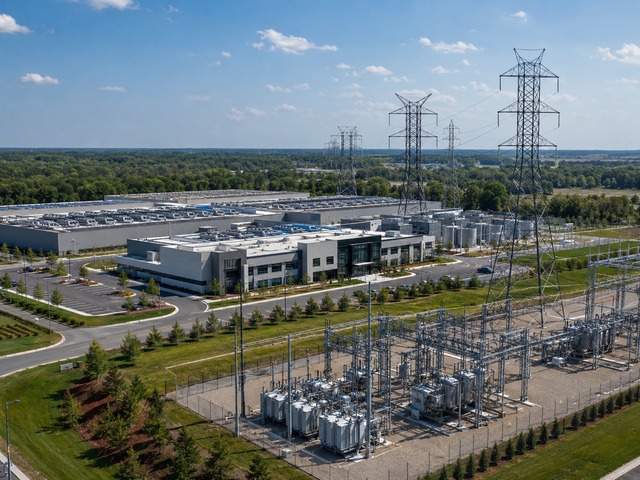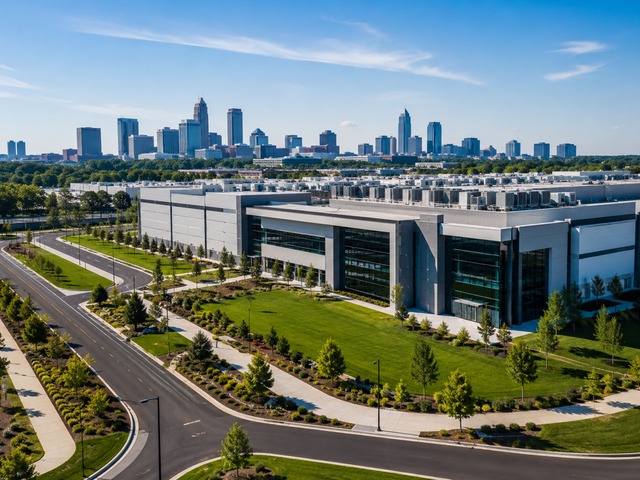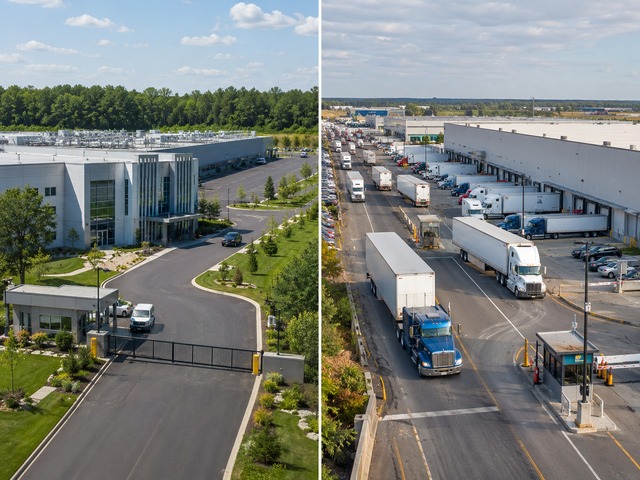
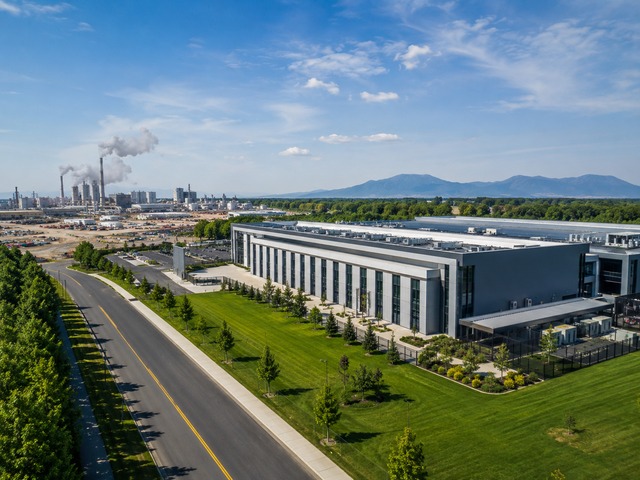
When communities weigh data centers against traditional industrial development, the environmental comparison is often misunderstood. Data centers consume significant electricity, and that consumption is visible in utility-scale procurement and grid load discussions. But electricity consumption is not the same as environmental impact — and when the full emissions, chemical, waste, and land-use profiles of data centers are compared against traditional heavy industry, the data center is consistently the cleaner option.
What Traditional Industrial Uses Actually Emit
Heavy industrial facilities — manufacturing plants, chemical processing, materials handling, large-scale logistics — generate emissions across multiple categories. Stack emissions from combustion processes release particulates, sulfur oxides, nitrogen oxides, and volatile organic compounds directly into the air. Vehicle fleets running diesel engines contribute continuous exhaust emissions in and around facility sites. Chemical storage and handling creates spill risk and groundwater contamination potential. Waste streams from manufacturing processes require treatment and disposal. Stormwater runoff from large impervious surfaces carries pollutants into local waterways.
These are not hypothetical concerns. They are the documented operational realities of industrial facilities across the country, regulated under the Clean Air Act, Clean Water Act, and RCRA frameworks that govern industrial pollution. Communities hosting heavy industry accept these impacts as the cost of the jobs and tax revenue those facilities provide.
The Data Center Emissions Profile
Data centers generate no stack emissions from manufacturing processes. There are no chemical inputs to production, no process waste streams, and no combustion other than backup generator testing and emergency operation. Microsoft’s global fact sheet notes that backup generator use due to actual power outages occurs on average once per year and accounts for less than one percent of total facility emissions. The primary environmental dimension of data center operations is electricity consumption — and that dimension is one that major operators are actively and measurably reducing.
Microsoft has committed to powering its data center, campus, and building operations with 100 percent renewable energy by 2025 through power purchase agreements for green energy. The commitment is operationalized through contracts for solar, wind, and other renewable generation capacity that offset the carbon associated with grid electricity consumption. Combined with the company’s carbon negativity goal for 2030, this represents a trajectory toward net positive environmental contribution from operations — a standard no traditional industrial facility approaches.
The broader industry is moving in the same direction. AMD’s research on sustainable AI infrastructure documents the efficiency gains from energy-efficient processor design, which reduces the electricity required per unit of AI computation. As chip efficiency improves and renewable energy penetration in the grid increases, the carbon intensity of data center operations declines even without changes in the facilities themselves.
Water: A More Complex Picture
Water consumption is a legitimate environmental concern for data centers, particularly those using evaporative cooling. Cooling towers and evaporative systems consume water to provide cooling effect, and in water-stressed regions this consumption warrants careful evaluation.
However, the water consumption profile of data centers compares favorably to many industrial alternatives. Manufacturing facilities often consume substantial water in production processes, in addition to cooling requirements. Agriculture — competing for the same rural land in many markets — is the largest water consumer in most western states. Data centers using modern liquid cooling and closed-loop water systems can operate with significantly reduced water consumption compared to evaporative alternatives.
Microsoft’s water positive commitment by 2030 includes piloting adiabatic cooling systems that use outside air instead of water when temperatures permit, and partnering on solar energy procurement that is expected to save more than 350 million liters of water annually compared to conventional electricity generation. The directional investment is toward lower water intensity, not higher.
Waste: The Circular Economy Approach
Traditional industrial facilities generate process waste in quantities that require active management, treatment, and disposal. Data centers generate primarily electronic waste from hardware lifecycle management — server replacements, component upgrades, and end-of-life equipment.
Major operators are implementing circular economy approaches to hardware lifecycle that significantly reduce the waste burden. Microsoft’s Circular Centers program aims to increase server and component reuse by up to 90 percent by 2025. Hardware that cannot be reused is processed through certified recycling programs that recover valuable materials and prevent hazardous components from entering landfills. All new Microsoft data center builds target zero-waste certification — a standard that requires 90 percent or more of construction and operational waste to be diverted from landfill.
The waste profile of a well-managed data center is dramatically better than that of a comparably sized manufacturing facility. There are no process chemicals, no hazardous waste streams from production, and no ongoing contamination risk from operational inputs.
Land Stewardship
Data centers are large facilities, and their land footprint is significant. But the land stewardship practices of major operators are substantially better than those of most industrial alternatives. LEED Gold certification — standard for new Microsoft builds — requires documented compliance with stormwater management standards, construction waste diversion requirements, site disturbance minimization protocols, and landscaping standards that protect or restore native vegetation.
The comparison with logistics development is instructive. A large distribution center covers similar acreage to a data center campus but generates far more impervious surface per unit of employment and tax revenue. Parking requirements for large hourly workforces create vast paved areas that generate stormwater runoff. Data centers have modest parking requirements — 50 employees per building does not require a sea of asphalt — and more of their land area can be managed as landscaped buffer with ecological value.
The Regulatory Accountability Difference
One dimension of the clean-versus-industrial comparison that deserves attention is regulatory accountability. Data center operators — particularly hyperscale operators — face public scrutiny of their environmental performance that most industrial tenants do not. Microsoft publishes annual sustainability reports with specific, audited metrics on carbon, water, and waste. These reports are reviewed by investors, regulators, and advocacy organizations.
The business case for environmental performance in the data center industry is therefore stronger than in most industrial categories. A hyperscale operator that fails to meet its public environmental commitments faces investor pressure, regulatory attention, and reputational risk that directly affects its ability to operate and expand. This accountability structure creates incentives for genuine environmental investment that industrial tenants rarely face.
Why This Matters
The perception that data centers are environmentally problematic — driven largely by their electricity consumption — understates the full picture. Electricity consumption is one dimension of environmental impact, and it is one that major operators are actively reducing through renewable procurement, efficiency investment, and technological innovation. On every other dimension — air quality, chemical hazard, waste generation, water contamination risk, and land stewardship — data centers compare favorably to the industrial alternatives competing for the same sites. Communities that make land use decisions based on a full environmental accounting, rather than a single-metric focus on electricity consumption, consistently find that the data center is the cleaner choice.
about
avada factory
Sempery ultricies nibh at dolor cras urna eleifend nec. Atiam efficitur tempor.