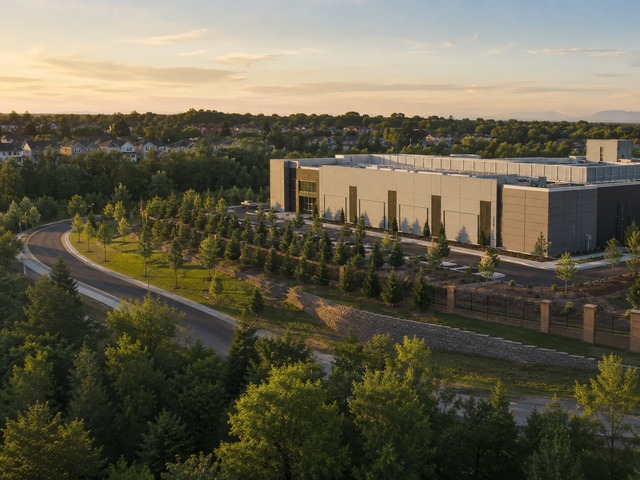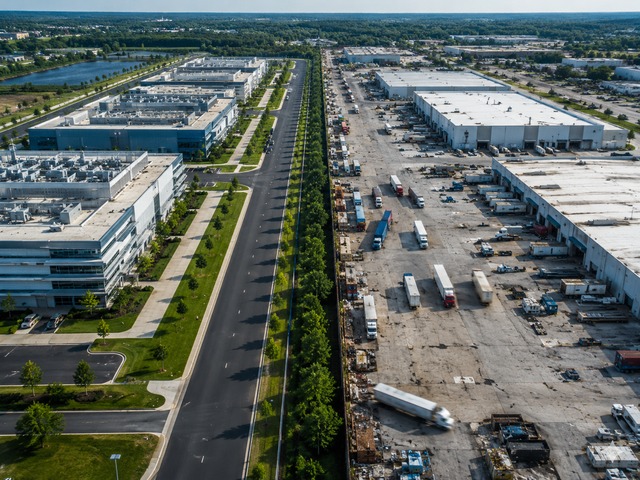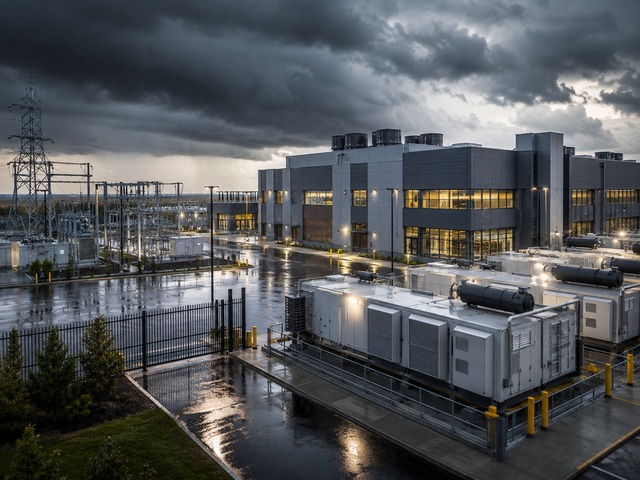
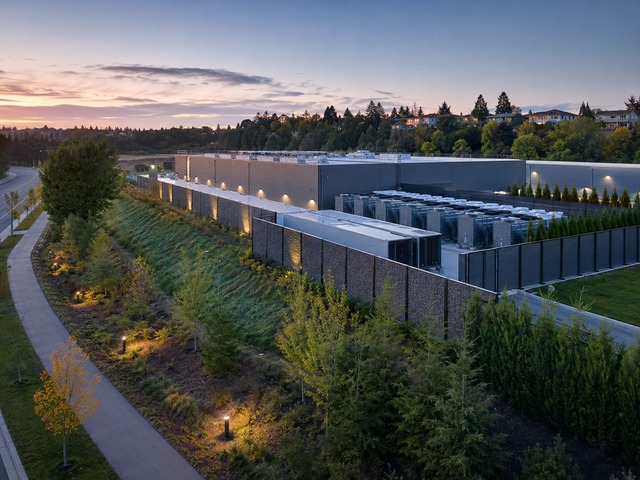
Noise is one of the most frequent concerns raised by communities evaluating data center proposals. Residents picture large industrial facilities running loud mechanical equipment around the clock, generating persistent sound that degrades quality of life for neighboring properties. That picture reflects a category of industrial facility that data centers are not. Modern hyperscale data centers are not built and then noise-managed — they are designed from the ground up with noise compliance as a fundamental constraint, using site-specific acoustic modeling, equipment selection, enclosure design, and landscaping to meet local ordinance requirements and protect neighboring properties.
The Four Sources of Data Center Sound
Understanding noise management at data centers starts with understanding what actually generates sound. According to Microsoft’s noise fact sheet, data centers have four primary sources of sound: servers, employee vehicles and occasional delivery traffic, backup generators, and cooling equipment. Each source is distinct in character, frequency, and engineering response.
Servers are the core computational infrastructure of any data center. They operate continuously, generating low-level sound from cooling fans and power supplies. Because servers are housed inside data center buildings, they are inaudible from outside the facility. The building envelope itself provides substantial sound attenuation, and server noise is therefore not a material concern for neighboring properties.
Employee and delivery traffic generates vehicle noise similar to any commercial workplace. Data centers employ relatively small staffs — approximately 50 employees per building across a 24-hour operating period — spread across multiple shifts. Unlike logistics facilities, there is no shift-change surge that concentrates hundreds of vehicles in a short window. Deliveries are occasional, not continuous. The traffic-related noise signature of a data center is therefore modest and intermittent.
Backup generators are the most significant potential noise source in a data center. They are large diesel-powered units designed to maintain facility operations during grid power outages. However, generators run infrequently — they are emergency backup systems, not primary power sources. Microsoft reports that generator activations due to actual power outages occur on average once per year. Generators are also tested periodically — monthly, quarterly, and annually — but these tests are brief, scheduled events, not continuous operations. The key engineering response to generator noise is attenuation: sound-absorbing enclosures built around generator units that significantly reduce sound transmission. Combined with the setbacks that typically place generators hundreds of meters from neighboring property lines, the noise impact of generator events is limited and manageable.
Cooling equipment is the most operationally continuous noise source in a data center. Cooling systems run around the clock because servers generate heat continuously and require constant temperature management. This is where the most significant engineering investment in noise management occurs.
Cooling Noise: The Engineering Challenge
Data center cooling systems range from indoor air handling units to outdoor cooling towers, dry coolers, and evaporative systems. The noise profile depends heavily on the cooling technology selected and the geographic and climatic context of the facility.
Indoor cooling equipment is housed inside the data center building and produces no meaningful external sound. The building envelope provides full attenuation. Facilities that can rely primarily on indoor cooling — including those using server-level liquid cooling systems that significantly reduce the heat load requiring removal — have minimal outdoor noise signatures from cooling systems.
Outdoor cooling equipment is required at many facilities and represents the primary continuous external noise source. Microsoft’s approach, documented in its noise fact sheet, involves collaboration between engineering teams and local authorities to understand and meet local noise requirements. Sound attenuation is added to outdoor equipment to reduce its noise signature to levels that meet ordinance requirements. Equipment is positioned on sites to maximize the distance between noise sources and neighboring property lines. Noise walls and earthen berms provide additional attenuation between equipment and surrounding properties.
Site-specific acoustic modeling is standard practice for major data center developers. Before a facility is built, acoustic engineers model the expected sound output of all noise sources at all relevant property lines under varying operational conditions. The model identifies locations where additional attenuation is needed and informs equipment placement, enclosure design, and landscaping decisions. This modeling process allows the developer to demonstrate compliance with local ordinance requirements before construction begins — and to commit to that compliance as a condition of approval.
Liquid Cooling and the Reduction of Outdoor Noise
One of the most significant recent developments in data center noise management is the expansion of liquid cooling at the server rack level. Traditional air cooling moves large volumes of conditioned air through data center spaces to remove heat from servers. This requires substantial air handling infrastructure, including fans, cooling coils, and outdoor heat rejection equipment.
Liquid cooling delivers cooling fluid directly to server components, removing heat far more efficiently than air. The result is a reduction in the volume of air that must be conditioned and the size of the air handling infrastructure required. Facilities using high-density liquid cooling can reduce the size and number of outdoor cooling units — which directly reduces the outdoor noise footprint of the facility.
As AI workloads drive server density higher, liquid cooling is becoming the standard approach for high-performance computing infrastructure. This technological shift is, incidentally, also a noise management improvement: higher-density liquid-cooled facilities require less outdoor mechanical infrastructure per unit of computing power than their air-cooled predecessors.
Comparison with Industrial Alternatives
The noise management engineering standard applied to data centers significantly exceeds what is typical for industrial facilities competing for the same land. Warehouses and logistics facilities generate continuous noise from truck operations, loading dock equipment, refrigeration systems, and vehicle traffic. Unlike data centers, these facilities do not routinely commission site-specific acoustic models or design noise attenuation into their facilities as a primary design constraint.
The regulatory environment also differs. Data centers are frequently subject to specific noise ordinance conditions as part of their use permits or conditional approvals. Operators agree to specific decibel limits at property lines and to engineering measures that ensure compliance. Violations of these conditions can result in enforcement actions that affect facility operations. This creates a strong regulatory and business incentive for noise management investment that industrial tenants typically do not face.
Design Techniques That Work
The suite of noise management techniques available to data center developers is well-established and consistently effective when properly applied. Noise barrier walls — solid masonry or prefabricated acoustic panels — can reduce sound levels at neighboring properties by 10 to 15 decibels depending on wall height and geometry. Earthen berms provide similar attenuation and can be landscaped to improve visual character simultaneously. Equipment enclosures built to specific acoustic specifications reduce generator and cooling unit noise at the source. Vibration isolation mounts prevent structure-borne sound transmission from mechanical equipment to building frames and foundations.
The combination of these measures, applied in response to site-specific acoustic modeling, consistently produces data center facilities that meet local noise ordinances and avoid generating material noise impacts on neighboring properties. The engineering tools exist. The regulatory framework requires their application. And the business case for compliance is strong, because a data center that generates neighbor complaints about noise faces a harder permitting environment for future projects and creates friction in its community relationships.
Why This Matters
Community concerns about data center noise are legitimate and should be addressed seriously — not dismissed. The appropriate response is not to minimize the concern but to demonstrate the engineering response. Modern data centers are designed to manage noise as a primary constraint, using acoustic modeling, equipment selection, attenuation technology, and operational protocols that industrial facilities rarely match. Communities that understand this engineering reality are better positioned to evaluate data center proposals accurately and to negotiate permit conditions that protect neighboring properties while allowing beneficial development to proceed.
about
avada factory
Sempery ultricies nibh at dolor cras urna eleifend nec. Atiam efficitur tempor.